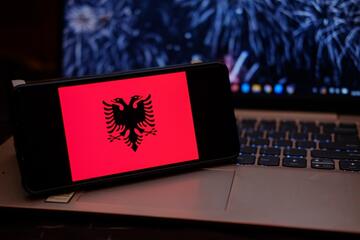
Albania: Social media platforms must protect media and public-interest accounts (Jambi - Shutterstock)
In recent days, a number of accounts have become inaccessible or restricted on Meta platforms. Meta subsequently acknowledged that some accounts had been removed incorrectly, restored affected accounts and indicated that additional safeguards were being applied. We welcome these corrective measures and Meta’s engagement with affected media and civil-society actors.
However, subsequent incidents, including sudden influxes of thousands of apparently fake followers and other indications of coordinated or abusive activity targeting public-interest accounts, suggest that the underlying vulnerability remains. Similar tactics have previously affected independent media in Serbia , where coordinated bot activity and malicious reporting contributed to account suspensions.
At this stage, there is no verified evidence identifying who is behind the recent activity in Albania, nor sufficient evidence to conclude that all affected accounts were targeted through the same mechanism or as part of a single operation. Any attribution to political, state or other actors must therefore be based on independently verified evidence.
The broader media-freedom concern is nevertheless clear. The design of online platform reporting, copyright and automated integrity mechanisms must not enable being weaponised against the very journalists, media and civic voices they are intended to protect. When malicious activity directed at an account results in that account being restricted or removed, platform enforcement risks amplifying the original attack. In this way, disruption of these channels can affect freedom of expression, media pluralism and the public’s access to information. The European Media Freedom Act reflects the importance of safeguards in this area by requiring that, for qualifying media service providers on very large online platforms, restrictions be imposed only with prior reasons, that there be an opportunity to respond, that complaints be given priority, and that meaningful dialogue be provided in cases of repeated restrictions. While Albania is not yet an EU Member State, these protections provide an important benchmark for platform responsibility and for the standards towards which candidate countries are moving.
The impact of such weaponization of online platform mechanisms is particularly serious in politically sensitive or repressive environments where journalists, independent media and civic actors are reporting on protests, government accountability and other matters of significant public interest. For smaller outlets and civic initiatives, social-media platforms may also represent their principal means of reaching audiences. Such contexts require online platforms to take measures with enhanced diligence.
Restoring wrongly removed accounts is necessary, but restoration alone is not enough. Platforms whose systems increasingly shape the reach of journalism and public-interest expression have a responsibility to ensure that those systems are safe, transparent, resilient against manipulation, and capable of protecting those targeted by coordinated digital attacks and access to reliable information. The EU Digital Services Act reflects this principle by requiring very large online platforms to mitigate systemic risks affecting fundamental rights and civic discourse. Although Albania remains an EU candidate country, these standards provide an important benchmark for platform responsibility.
MFRR and SafeJournalists call on Meta and other major platforms to ensure that:
- journalists, media and public-interest accounts targeted by malicious third-party activity are not penalized as a consequence of that activity;
- potentially erroneous content or account restrictions receive rapid and meaningful human review;
- journalists and media organizations facing account suspensions, coordinated attacks or other restrictions that can disrupt public-interest reporting have access to a clearly identifiable, rapid escalation channel, with priority human review and reasoned decisions rather than having to rely solely on standard user-reporting and appeal routes;
- platforms investigate coordinated reporting, bot attacks, copyright abuse and other attempts to manipulate enforcement systems; and
- Put in place appropriate proactive safeguards and mitigation measures to protect media and public-interest accounts at heightened risk.
We also encourage Meta to communicate, at least in aggregate, the outcome of its review of the recent Albanian cases and the measures taken to prevent similar incidents.
The SafeJournalists Network and MFRR partners will continue to monitor developments in Albania and the wider Western Balkans and support journalists, media workers and civic actors facing threats, intimidation or interference.
Signatories
Media Freedom Rapid Response partners
European Federation of Journalists (EFJ)
Free Press Unlimited (FPU)
OBC Transeuropa (OBTC)
European Center for Press and Media Freedom (ECPMF)
SafeJournalists Network
Association of Journalists of Albania
Association of Journalists of Kosovo
Association of Journalists of Macedonia
BH Journalists Association
Croatian Journalists’ Association
Independent Journalists’ Association of Serbia
Trade Union of Media of Montenegro
Reporters without Borders (RsF)
Reporting Diversity Network (RDN)
International Federation of Journalists
Tags: Albania Media freedom Freedom of expression Media pluralism
This content is part of the Media Freedom Rapid Response (MFRR), a Europe-wide mechanism which tracks, monitors and responds to violations of press and media freedom in EU Member States and Candidate Countries. The project is co-funded by the European Commission.

