
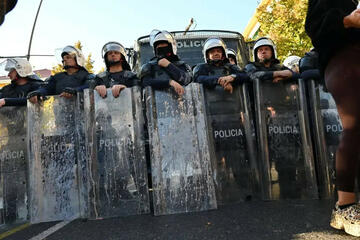
Protests in Tirana - E.Kryeziu/OBCT
Tirana, 14 October 2026
Addressed to:
- Mr Niko Peleshi, Speaker of the Parliament of Albania
- Mr Ervin Demo, Minister of Interior
- Mr Toni Gogu, Minister of Justice
- Ms Jorida Tabaku, Chair of the Parliamentary Committee on Human Rights and Public Information Media
- Mr Fatmir Xhafaj, Chair of the Parliamentary Committee on Citizens’ Initiatives, Cooperation and Institutional Oversight
- Mr Ulsi Manja, Chair of the Parliamentary Committee on Legal Affairs and Public Administration
- Mr Olsian Çela, Prosecutor General
- Mr Skender Hita, General Director of the Albanian State Police
- Mr Klevis Qose, General Director of the Police Oversight Agency
- Mr Endrit Shabani, People’s Advocate of Albania
Cc: Ms Sofia Moreira de Sousa, EU Ambassador to Albania; Ms Giulia Re, Head of the Council of Europe Office in Tirana; Ambassador Michel Tarran, Head of the OSCE Presence in Albania.
Subject: Urgent institutional action and accountability following repeated violence and obstruction affecting journalists and public watchdogs
Dear Ministers, Mr Speaker, Committee Chairs and Heads of Institutions,
We, the undersigned organisations, express our deep concern over repeated incidents of violence and obstruction affecting journalists and media workers covering protests in Albania, as well as the lack of effective institutional responses and preventive measures despite successive public warnings.
The events of 13 October 2026 in Tirana, during which several journalists reported physical assaults and obstruction by police officers and three media workers required hospital treatment, demand urgent action. Particularly alarming is the case of Izmir Akulli, editor-in-chief of Dosja.al , who reported being beaten by police officers while documenting their actions and required hospital treatment.
These events follow documented incidents in July , the repeated detention and obstruction of Citizens.al journalist Vjolanda Peca, including the retention of her telephone in September (alert registered also on the Council of Europe Safety of Journalists platform), and the obstruction of identifiable media crews on 8 October . The recurrence of these incidents, despite repeated public warnings and the adoption of the State Police Guidelines for the Safety of Journalists in May 2025, raises serious concerns about the gap between institutional commitments and their implementation in practice. It also calls for a clear public account of the measures taken in response to previous incidents and why they have failed to prevent further violence and obstruction.
These incidents must also be understood within the broader cumulative pressures affecting media freedom and civic space in Albania . Smear campaigns, intimidation, gender-based attacks, restrictions affecting media and civic accounts on digital platforms, obstacles to accessing public-interest information and proposed legal restrictions on reporting contribute to an increasingly difficult environment for independent scrutiny. The cumulative impact of these pressures risks discouraging reporting, public criticism and civic participation, while weakening the ability of journalists and civil society to hold public authorities accountable.
The State’s obligation to protect fundamental rights extends to journalists, camera operators, photojournalists, freelance reporters, human rights defenders, independent protest monitors, and other civil society actors who document and act on matters of public interest. They must be able to carry out their legitimate activities without violence, intimidation or unlawful interference.
We therefore call for urgent action and accountability from the responsible institutions, in line with their respective mandates:
- We call on the Albanian State Police to urgently address the reported violence and obstruction against journalists and media crews during the protests of 13 October 2026, publicly clarify the circumstances of the incidents and ensure that all relevant evidence is preserved and made available to the competent investigative authorities. We further urge the Police to take immediate preventive measures, fully implement the Guidelines for the Safety of Journalists and guarantee safe and unobstructed reporting and independent monitoring of public assemblies, particularly during the deployment of crowd-control measures.
- We urge the Ministry of Interior to address the repeated allegations of excessive and disproportionate police force, examine the institutional response to incidents documented since July 2026, and publicly explain what measures have been taken to address shortcomings in police conduct, supervision and accountability and to prevent their recurrence.
- We call on the Police Oversight Agency to conduct prompt, independent and effective investigations into the reported police violence and obstruction, including the incidents of 13 October and previously documented cases, and to ensure that suspected criminal offences are referred to the competent prosecution authorities.
- We call on the competent prosecution authorities to promptly, independently and effectively investigate alleged criminal offences committed against journalists, including during the events of 13 October, and to hold those responsible to account in accordance with the law.
- We urge the Ministry of Justice, within its mandate, to assess and strengthen the legal safeguards for the effective protection of journalists, media workers and public watchdogs against violence, intimidation and obstruction in the exercise of their work, as well as their access to effective legal remedies.
- We call on the People’s Advocate to independently examine the repeated incidents of alleged police violence and obstruction affecting journalists and public watchdogs during protests, assess compliance with fundamental rights standards and issue recommendations to prevent further violations.
We also urge the Parliament of Albania to exercise its oversight responsibilities by convening a parliamentary hearing on repeated incidents affecting journalists and public watchdogs, the responses of competent institutions and the implementation of existing safeguards. The hearing should involve the responsible authorities and representatives of journalists and civil society, with its findings and recommendations made public and subject to follow-up.
We call on the responsible institutions to publicly report on the actions taken, their outcomes and the measures adopted to prevent similar incidents from recurring.
We further urge the European Union, Council of Europe and OSCE to closely follow these developments and raise the concerns in their engagement with the Albanian authorities. Effective protection of journalists, freedom of expression, institutional accountability and meaningful civic participation are integral to Albania’s commitments under Cluster 1 – Fundamentals, particularly Chapter 23 on Judiciary and Fundamental Rights. Progress towards EU accession must be assessed not only through legislative commitments, but also through their effective implementation.
The responsibility to maintain public order cannot justify disproportionate force, violence or interference with independent reporting and legitimate public-interest monitoring. Violence against journalists, regardless of its source, is unacceptable. When incidents recur despite repeated warnings, the effectiveness of institutional safeguards and accountability becomes a matter of urgent public concern.
The safety of journalists and the ability of citizens and civil society to scrutinise public authority are essential to democratic accountability.
We stand in solidarity with journalists, media workers, human rights defenders and public watchdogs facing violence, intimidation or obstruction and remain committed to defending their safety, fundamental freedoms and right to scrutinise public authority without fear or retaliation.
Sincerely,
Undersigned organisations
International Press Institute (IPI)
European Federation of Journalists (EFJ)
Committee to Protect Journalists (CPJ)
Reporters Without Borders (RSF)
Osservatorio Balcani Caucaso Transeuropa (OBCT)
Free Press Unlimited (FPU)
South East Europe Media Organisation (SEEMO)
SafeJournalists Network
Association of Journalists of Albania
Association of Journalists of Kosovo
Association of Journalists of Macedonia
BH Journalists Association
Croatian Journalists’ Association
Independent Journalists’ Association of Serbia
Trade Union of Media of Montenegro
Albanian civil society organisations:
Center Science and Innovation for Development (SCiDEV)
Albanian Woman in Audiovisual (AWA)
Albanian Media Council (KSHM)
Albanian Center for Quality Journalism (ACQJ)
Res Publica Center
The Association of Professional Journalists of Albania (APJA)
Balkan Investigative Reporting Network Albania (BIRN Albania)
Social Justice
Union of Albanian Journalists (UGSH)
Albanian Media Institute (AMI)
Partners Albania for Change and Development
Civic Resistance
Institute of Political Studies (ISP)
Center for the Study of Democracy and Governance (CSDG)
Institute for Democracy and Mediation (IDM)
Citizens.al
Faktoje.al
Tags: Albania Media freedom Safety of journalists Freedom of expression
This content is part of the Media Freedom Rapid Response (MFRR), a Europe-wide mechanism which tracks, monitors and responds to violations of press and media freedom in EU Member States and Candidate Countries. The project is co-funded by the European Commission.

