
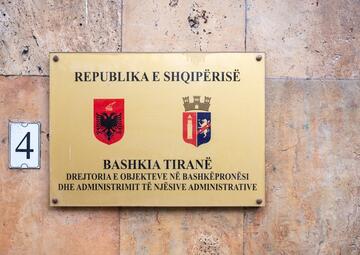
Sign of the Ministry of Justice and the Governmental administrative center in Tirana, Albania. Credits: Werner Lerooy, Shutterstock.
To: Mr. Toni GOGU, Minister of Justice of the Republic of Albania, Ministry of Justice, Tirana
Cc:
- Mr. Ulsi Manja, Chair of the Parliamentary Committee on Legal Affairs and Public Administration
- Mrs. Jorida Tabaku, Chair of the Parliamentary Committee on Human Rights and Means of Public Information
- Mrs. Adea Pirdeni, State Minister for Public Administration and Anti-corruption
- Ms. Sofia Moreira de Sousa, EU Ambassador to Albania
- Mrs. Giulia Re, Head of the Council of Europe Office in Tirana
- Prof. Mark Marku, Chair of the Media Dialogue Platform
Subject: Strengthening Albania's framework against Strategic Lawsuits Against Public Participation (SLAPPs)
Dear Minister Gogu,
The undersigned European and regional media freedom organizations and Albanian civil society organisations welcome the draft anti-SLAPP law and the progress made towards establishing stronger safeguards for journalists, media workers, civil society and others engaged in public participation.
The draft contains important protections that should be preserved and built upon. In particular, its application to both domestic and cross-border proceedings goes beyond the minimum scope of the EU Anti-SLAPP Directive and is especially relevant in the Albanian context. We also welcome the dedicated legislative framework, the 60-day deadline for decisions on security and early dismissal, and the provisions on costs, compensation and third-country proceedings.
These positive elements are also reflected in the legal assessment prepared by Council of Europe experts under the EU–Council of Europe project Promoting Freedom of Expression in Albania through Open Dialogue, which finds the draft broadly aligned with EU and Council of Europe standards while identifying a number of targeted amendments to further strengthen its legal clarity and effectiveness.
As the Ministry revises the draft ahead of formal public consultation, we call on it to ensure that:
- The early-dismissal mechanism is legally effective. Article 9 should clearly state that a decision granting early dismissal is a decision on the merits, rather than a procedural discontinuance, and should clarify the timing of applications, partial dismissal, suspension of the main proceedings, and the treatment of appeals.
- The definition of abusive proceedings in Article 3(3) is revised. Proceedings should not have to involve a “manifestly unfounded” claim in order to qualify as abusive. The definition should also capture fully or partly unfounded claims pursued abusively, while manifest unfoundedness should remain the threshold for early dismissal.
- The safeguards are workable in practice. The final law should provide clear rules on security for costs, recovery of reasonable defense costs, damages and sanctions; accessible information on available legal and other support; systematic identification and monitoring of cases; publication of relevant judgments; and appropriate training. Safeguards for confidential journalistic sources and anonymous participants should also be considered, and adequate resources should be provided to implement them.
We also urge the Ministry to address the continued criminalization of defamation and insult as part of this wider reform. Leaving criminal proceedings available for expression on matters of public interest risks undermining the effectiveness of the new civil anti-SLAPP safeguards, as abusive legal action may simply shift to the criminal route. The legal assessment therefore recommends full decriminalization, including repeal of the relevant Criminal Code provisions (Articles 119, 120 and 318). If these offenses are retained, appropriate anti-SLAPP safeguards should also apply to criminal proceedings arising from public participation. This is also consistent with Albania’s EU accession commitments.
At the same time, decriminalization must be accompanied by effective and proportionate civil remedies for legitimate reputational harm, fully aligned with European freedom-of-expression standards. The civil defamation framework needs to be aligned with European standards as an outstanding issue requiring separate review.
Finally, we encourage the Ministry to ensure a meaningful and inclusive public consultation before the draft moves forward. The revised text should be published with adequate time for journalists, media organizations, civil society, legal professionals, academics and other relevant stakeholders to provide substantive input, and the comments received should be duly considered before the draft is submitted to Parliament.
We welcome the Ministry of Justice's constructive engagement to date and encourage it to incorporate these recommendations into the next version of the draft. The passing of an anti-SLAPP law which includes these additional elements would be recognized as a positive development for media freedom in Albania at the European and international level. Our organizations remain available to contribute to the consultation and the further development of the legislative framework.
Yours sincerely,
Signatories
Reporters Without Borders (RSF)
International Press Institute (IPI)
Free Press Unlimited (FPU)
Osservatorio Balcani Caucaso Transeuropa (OBCT)
South East Europe Media Organisation (SEEMO)
European Federation of Journalists (EFJ)
European Center for Press and Media Freedom (ECPMF)
SafeJournalists Network
- Association of Journalists of Albania
- Association of Journalists of Kosovo
- Association of Journalists of Macedonia
- BH Journalists Association
- Croatian Journalists’ Association
- Independent Journalists’ Association of Serbia
- Trade Union of Media of Montenegro
Albanian civil society organisations
- Center Science and Innovation for Development (SCiDEV)
- Albanian Media Council (KShM)
- Balkan Investigative Reporting Network in Albania (BIRN Albania)
- Albanian Helsinki Commitee (KShH)
- Albanian Media Institute (AMI)
- Center Citizens Channel (Citizens.al)
- Center Faktoje
- Partners Albania for Change and Development
- Albanian Center for Quality Journalism
This content is part of the Media Freedom Rapid Response (MFRR), a Europe-wide mechanism which tracks, monitors and responds to violations of press and media freedom in EU Member States and Candidate Countries. The project is co-funded by the European Commission.

