
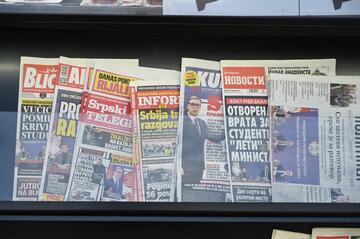
Serbian tabloids, daily and weekly newspapers on the shelf in the shop. Credits: Ajdin Kamber for Shutterstock
Serbia’s parliamentary elections on 25 October marked a significant political change. The Student List which emerged from two years of student-led anti-corruption protests won a majority and Aleksandar Vučić conceded defeat after 12 years in power.
The partners of the Media Freedom Rapid Response (MFRR) see this result as an opportunity to strengthen media freedom and pluralism. After years of mounting pressure on independent journalism, political interference and attacks against media professionals, the post-election period offers a chance to address longstanding problems.
Whether this opportunity leads to lasting change will depend on the commitment of the future government and Serbian institutions to accountability for past violations, independent institutions and structural reforms that protect journalists and editorial independence, regardless of who holds political power.
Journalists faced intimidation and obstruction throughout the electoral period
The elections took place against a backdrop of serious deterioration in media freedom. In our joint statement with the SafeJournalists Network (SJN) on 21 October, we warned that escalating violence against journalists, political hostility towards independent media and persistent impunity threatened the conditions necessary for democratic elections.
On election day, two MFRR observers monitored the situation of journalists covering the elections alongside members of the Permanent Working Group on Safety of Journalists (PWGSJ).
Throughout the campaign, journalists faced threats, intimidation and obstruction while carrying out their work. On election day, further incidents were reported, including the injury of journalists Mihailo Stojković and Jelena Stojković at a polling station in Pavlovac, restrictions on reporting at polling stations across Serbia, and the denial of entry to Serbia to two Croatian journalists and a television crew from North Macedonia. Two additional physical attacks were reported: one targeting three journalists from Blokada Info in Bežanijska Kosa, as well as a journalist and podcast host who was assaulted outside Pionirski Park, according to Vreme.
Independent media outlets also faced restrictions on access to political events and regulatory pressure. N1, Nova, Danas and Radar were denied accreditation to cover election night at the headquarters of the Serbian Progressive Party (SNS), while N1 and Nova were accused of violating pre-election silence rules in a statement attributed to the Regulatory Authority for Electronic Media (REM), whose authenticity was subsequently disputed by other members of the regulator. These incidents raise concerns about equal treatment of journalists, access to information and the impartial application of media regulation during elections.
Several independent media outlets also reported suspected coordinated online attacks in the days preceding the elections, including activity apparently intended to trigger the suspension of their social media accounts. Danas separately reported attacks against its website. The Journalists’ Association of Serbia (UNS) website also experienced disruptions, but it is not yet clear whether this was the result of a deliberate attack.
These incidents reflect a broader pattern documented by Mapping Media Freedom, MFRR international monitoring missions and Serbian journalists’ associations. In 2026 alone, 157 attacks affecting 261 journalists and media outlets had been documented ahead of the elections, following 209 incidents in 2025. The international election observation mission also highlighted violence, threats and harassment against journalists, as well as political and economic pressures undermining editorial independence.
The MFRR partners condemn the continuing spiral of violence and intimidation against journalists, as well as the climate of impunity that has allowed such violations to persist. Journalists must be able to report freely and safely, particularly during elections, when access to independent and reliable information is essential to democratic participation.
Following the elections, protesters entered the premises of Informer TV, confronted staff and interrupted its broadcast. Demonstrators also gathered outside Pink TV and the public broadcaster RTS. The MFRR partners condemn any intimidation of journalists and media workers, regardless of their editorial positions, and welcome the student movement’s calls for calm. Media reform must be pursued without intimidation or political retaliation, with full respect for editorial independence.
Beyond threats to individual journalists, the wider media environment raises serious concerns about the conditions for informed democratic participation. Political influence over broadcasters, unequal access to media coverage and pressure on independent outlets can undermine citizens’ ability to receive diverse and reliable information. These concerns were reinforced by the preliminary findings of the OSCE/ODIHR election observation mission, which identified significant imbalances in media coverage, including favourable coverage of the ruling party and predominantly negative coverage of the Student List. The observers also raised concerns about voters’ access to impartial information.Addressing these structural problems is essential to ensuring media pluralism, including in future elections.
Addressing the structures of media capture
The challenges facing Serbian journalism extend well beyond physical attacks and intimidation. Previous MFRR monitoring missions have documented concerns about political influence over media ownership and distribution, the use of public resources and state advertising, the independence of the REM, and political pressure on public service broadcasting.
Pressure on the editorial independence of Nova.rs, Nova.tv and N1 persisted during the electoral period, amid recent ownership and management changes involving the Portuguese Alpac group. Notable examples included an offer to Nova.rs of temporary staff with previous affiliations to pro-government and pro-Kremlin media for a three-month period, and a reported 48-hour ultimatum to Nova.rs staff to accept new editorial leadership or leave. The news director of Nova.tv told MFRR observers that the new management had also offered him the option of leaving, which he declined. In early October, despite earlier promises, the new owners reportedly sought Serbian broadcasting licences from REM for N1 and Nova. Editorial staff had not been informed of this move, raising further concerns about their independence. Lastly, despite an earlier agreement that Alpac representatives present on election night would not interfere in editorial decisions, Nova.tv's election-night broadcast was reportedly cut short following an intervention by representatives of the group.
These problems cannot be resolved simply by replacing the political actors exercising influence over the media. Serbia needs safeguards that prevent any government from using regulatory powers, public funding, state-owned companies or media ownership structures to reward favourable coverage or punish critical journalism. Editorial independence must be protected not only from direct political interference, but also from indirect pressure exercised through ownership, financing and distribution.
The independence of public service media must also be strengthened. RTS should serve the public interest and provide impartial, pluralistic and independent journalism, rather than operate under political influence. Similarly, REM must be able to exercise its regulatory responsibilities independently, transparently and effectively.
An opportunity for lasting reform
We encourage the Serbian authorities and the future government to make media freedom and pluralism a priority from the outset and to engage in an inclusive reform process with journalists, independent media organisations, professional associations and civil society.
Reforms must be guided by international freedom of expression standards and implemented through transparent, accountable and inclusive procedures. They must not become instruments of political retaliation or allow existing structures of media capture to pass into different hands.
The MFRR partners call on the Serbian authorities and the future government to:
- Guarantee journalists’ safety and end impunity, including during the post-election period, by ensuring effective, independent investigations and accountability for attacks, threats and intimidation, including violations committed in previous years, and guaranteeing journalists' non-discriminatory access to electoral events and information.
- Strengthen the independence of REM and public service media, through transparent appointments, effective oversight, safeguards against political influence and guarantees of impartial and pluralistic political coverage.
- Address structural media capture, including opaque ownership, politically influenced state advertising, the role of state-owned companies in media markets and discriminatory access to distribution infrastructure, through transparent rules, independent oversight and effective safeguards against political interference.
- Protect editorial independence, including at N1, Nova and other independent outlets, through effective safeguards against political, commercial and ownership-related interference, including interference in newsroom management and editorial decisions.
- Develop a transparent and inclusive media reform agenda, with concrete commitments, measurable milestones and meaningful participation by journalists’ associations and civil society.
The European Union must translate monitoring into meaningful reform
We call on the European Union and its Member States to make media freedom and pluralism a priority in their engagement with Serbia and throughout the EU accession process.
The European Commission should translate the findings of its annual Rule of Law Reports, enlargement assessments, OSCE/ODIHR election observation findings and international media freedom monitoring into concrete, measurable reform benchmarks, and assess their implementation in successive enlargement reports.
These reforms should focus on journalists’ safety and accountability for attacks against them, independent media regulation and public service broadcasting, transparent media ownership and state advertising, and effective safeguards against media capture. Relevant European standards, including those reflected in the European Media Freedom Act, should guide Serbia’s reform efforts. The EU should accompany this process with sustained political engagement and continued support for independent journalism.
Building lasting guarantees for media freedom and pluralism
Serbia’s journalists have continued to inform the public despite years of intimidation, violence and political pressure. Their courage deserves recognition, but their safety and independence must no longer depend on individual resilience or solidarity networks.
The post-election period offers an opportunity to establish lasting institutional guarantees for media freedom and pluralism, irrespective of who holds political power. The MFRR partners will continue to monitor developments and support Serbian journalists and media organisations in their efforts to achieve meaningful reforms.
Signed by
European Centre for Press and Media Freedom (ECPMF)
Free Press Unlimited (FPU)
ARTICLE 19 Europe
European Federation of Journalists (EFJ)
International Press Institute (IPI)
Osservatorio Balcani Caucaso Transeuropa (OBCT)
Tags: Serbia Media freedom Media pluralism Safety of journalists Freedom of expression
This content is part of the Media Freedom Rapid Response (MFRR), a Europe-wide mechanism which tracks, monitors and responds to violations of press and media freedom in EU Member States and Candidate Countries. The project is co-funded by the European Commission.

