
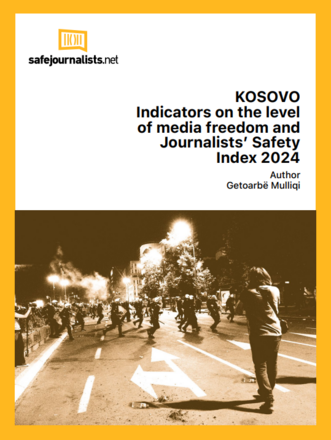
In the report, the author used three indicators to assess media freedom and journalists’ safety: a) legal safeguards and their implementation, b) journalists’ position in the newsrooms, and c) journalists’ safety. Furthermore, the Journalists’ Safety Index relies on quantitative data collection to “measure” changes that affect how journalists perceive themselves while carrying out their work. The Journalists’ Safety Index consists of four key indicators: (i) the legal and organizational environment; (ii) prevention measures; (iii) due process; and (iv) actual safety.
Regarding the legal framework, Kosovo’s Constitution and laws guarantee freedom of expression, in practice the reality is different, as the government exercises pressure on media and regulatory bodies. The 2024 amendments to the Independent Media Commission (IMC) law were drafted through a non-transparent process and without meaningful stakeholder engagement. Additionally, the Kosovo Assembly failed to appoint new IMC members, leaving the body without a quorum and exacerbating shortcomings, such as limited transparency and fragile independence. The report finds no real political will to reform and depoliticize RTK, which remains dysfunctional due to leadership and board members' resignations. As the only state-funded media, RTK contrasts with other media that rely on advertising and operate online, especially since print media disappeared in Kosovo after 2020. Additionally, there are no specific legal protections against SLAPP lawsuits.
As for journalists’ position in newsrooms, journalists in Kosovo face poor working conditions worsened by the absence of a trade union, with many underpaid and employed on short-term contracts, while facing pressure to avoid certain topics. Women journalists encounter these same issues alongside additional challenges, including structural barriers to advancement, gender stereotyping, lack of institutional support, and gender-based harassment and threats.
Journalists’ safety in Kosovo is deteriorating, marked by underreporting of incidents, weak institutional coordination, and a lack of trust in authorities. The absence of tailored reporting channels, risk-assessment procedures, and a coordinated national protection mechanism leaves journalists vulnerable to both physical and digital threats. Attacks—often linked to political actors—are increasingly severe, including death threats, gender-based harassment, and online smear campaigns, particularly targeting women and those covering sensitive issues. Overall, insufficient accountability and fragmented safety efforts have created a climate of impunity, leaving journalists largely unprotected.
The third chapter provides conclusions and clear recommendations linked to the three indicators.
Tags: Kosovo Safety of journalistsThe content of this article can be used according to the terms of Creative Commons: Attribution-NonCommercial 4.0 International (CC BY-NC 4.0) . To do so use the the wording "this article was originally published on the Resource Centre on Media Freedom in Europe" including a direct active link to the original article page.
